
BIRTH
Henie Lea was born on August 13, 1881 in house number 199 in Rohatyn to musician Moses Faust and Cypre Rosa Leuchtling. The midwife assisting in the delivery was Etel Wandmeyer. The marriage of Moses and Cypre Rosa was labelled as ‘presumed’ despite the attestation and signature of Alter Joresch on the birth record as witness to the parents marriage. Henia Lea was named in the synagogue on August 20th and the blessing was given by Hersch Willig. A notation in the comments portion of the record marked by a “+” character denotes a date of death for Henie Lea as July 24, 1886.

The choice of naming a child born during the 1800s in Rohatyn as Henie Lea occurred more often from members of the Faust and Schwarz families than any other families. Daughters born 1880 through 1900 to Perl Brandwein née Faust, Kalman Schwarz and David Schwarz were given the name ‘Henie Lea’ which suggests the naming connection is on Moses’s side of the family and further strengthens the probability of direct relation between the the Faust and Schwarz family.
DEATH
Henie Lea Faust died less than a month before her 5th birthday at 9pm on July 24, 1886 in house number 98 in Rohatyn. The body of Henie Lea was examined by Dr. Władysław Węgrzynowski on July 25th and assigned this death event as number 102. His diagnosis for the cause of death was given as emaciation (wyncędznienie) suggesting she suffered from a chronic illness or infection. Its possible she died of a gastrointestinal infection known as Summer Diarrhea (Letnia biegunka) caused by proliferation of bacteria in water and food due to lack of refrigeration and water treatment in the summer heat. Another cause of death could have been from Cholera which was highly prevalent during the summer months of 1886.

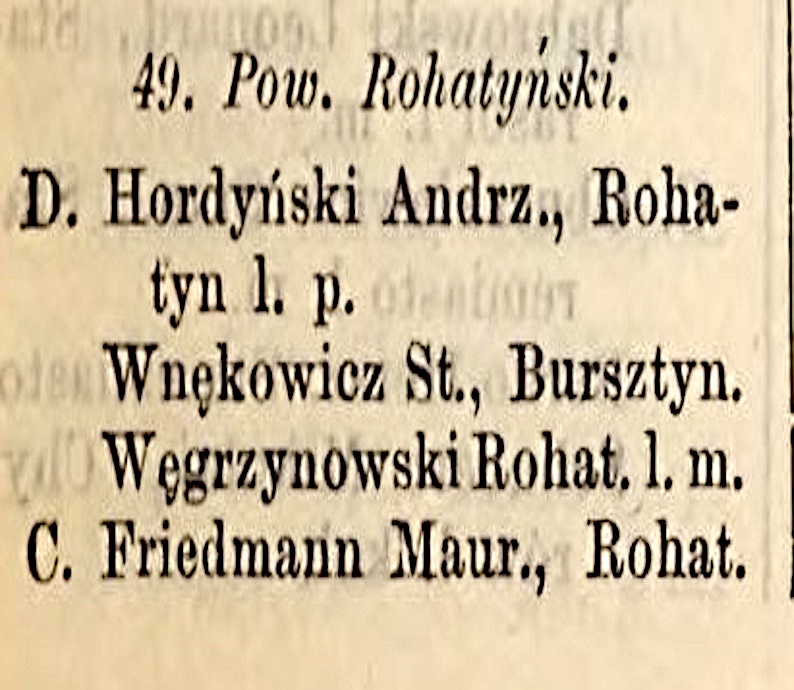
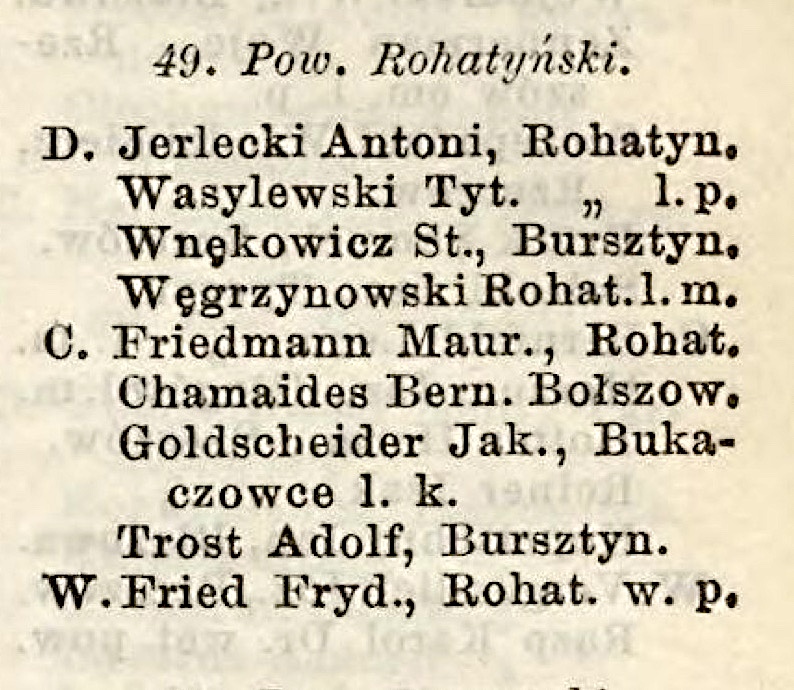
Dr. Władysław Węgrzynowski (4/3/1857-5/2/1895 Zbaraz) was a physician for the town of Rohatyn from 1884 to 1891. Listings in Kalendarz Lekarski show his name followed by the credentials ‘l.m.’ which is an abbreviation for lekarz miejski (city physician).
I was interested in the number 102 assigned to this death event and found it relates to a policy initiated by the Austrian-Hungarian government on the proper procedure of burials.
In 1870, the Austrian-Hungarian government established the Sanitary Law which included the formal process of issuing death certificates. Under this law, a body could not be buried until it was examined by a corpse examiner (Oglądacz zwłok) who was usually the local physician. When a person died, the doctor would be called to come to the home to examine the body and provide a cause of death. If the death was not due to foul play or a contagious infection, the physician would issue an examination card (karta oględzin zwłok example) or a posthumous card (karta pośmiertna example) to certify the death. The physician kept a book of blank cards for each year of practice. Cards were sequentially numbered with a Sanitary Certificate Number otherwise referred to as the postmortem examination certificate number (Numer świadectwa oględzin zwłok). The physician would fill out the card with the details of the deceased and the cause of death and then tear it from the book (Blok świadectw) keeping a receipt with the corresponding serial number as the stub in the book. The card was then given to the local parish to record the death in their registry and used to obtain a burial certificate. Henie Lea was buried on July 26, 1886 in the local Jewish cemetery.
QUESTIONS
- Who was Henie Lea named after?
 Genealogy by Alex

