
I have been using the little bit of free time I have to delve more into my own family history and retrace some of the steps I took many years ago. I thought at the same time I would write about my methods and findings in some sort of blog. Hopefully it will spark some discussion and possibly we may all learn something new. After recently reading about immigration files, I went back to look at the ship manifest of my mother, aunt, and grandparents which I had found on ancestry.com.
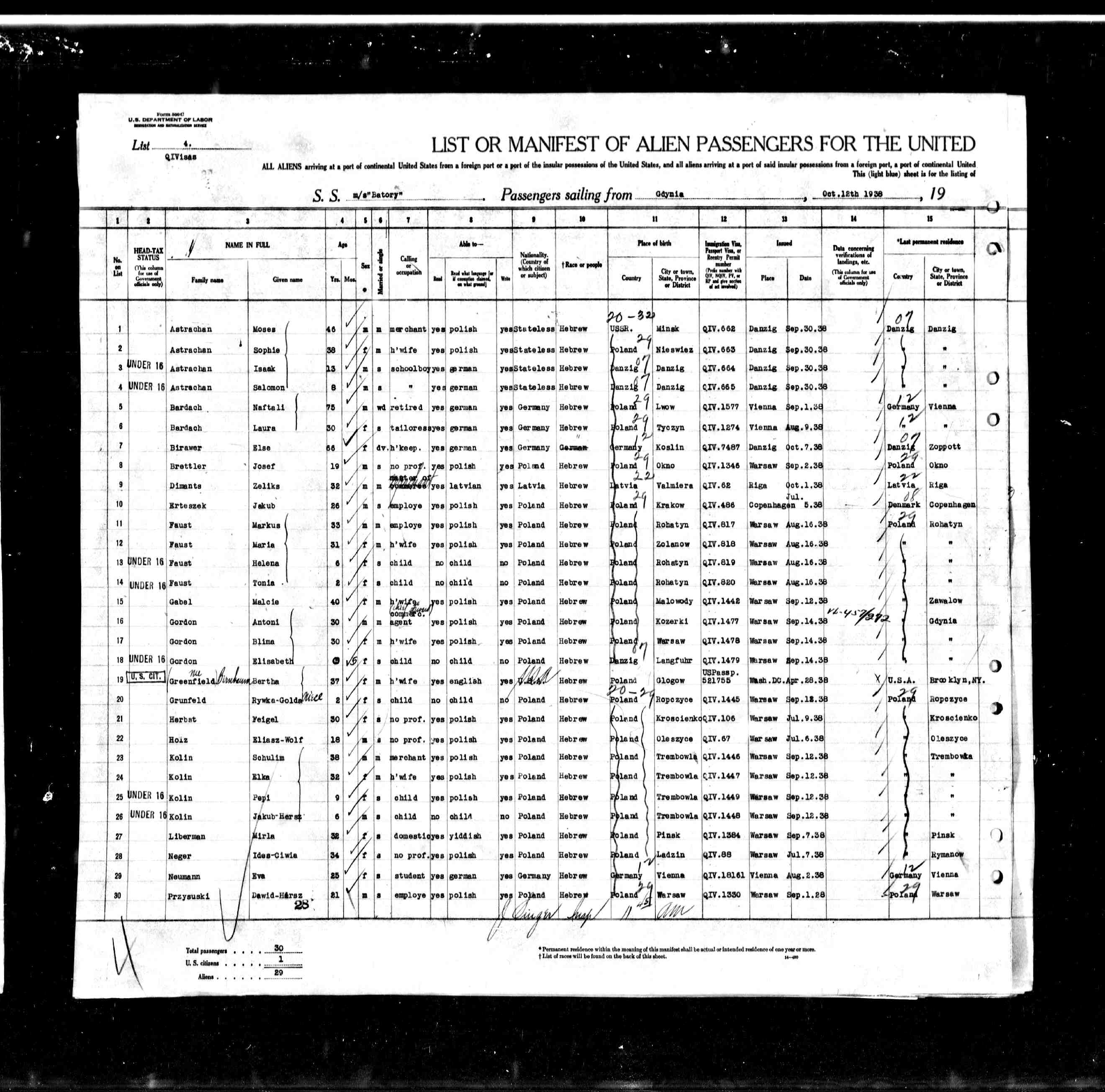

Lines 11-14: Markus (33), Maria (31), Helena (6), and Tonia (2) departed on October 12, 1938 from Gdynia onboard the SS Batory as third cabin passengers. Markus, Helena, and Tonia were born in Rohatyn while Maria was born in the nearby town of Zalanow. All were residing in Rohatyn prior in departure. Tonia is my mother Annette.
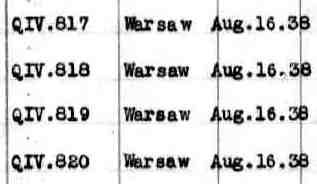
The less well known data in this ship manifest are the details about the visa. They had a QIV (Quota Immigrant Visa) with progressive US Dept of State numbers issued by the US Consul in Warsaw on August 16, 1938. Knowing nothing about this visa and the process, I searched and found an infofile on Jewishgen describing this visa. http://www.jewishgen.org/infofiles/manifests/other/visa/
I sought to obtain a copy of their visa application. This lead me to the USCIS genealogy program where I can request to search for immigration files in their records. http://www.uscis.gov/genealogy. They have:
- Naturalization Certificate Files 1906-1956
- Alien Registration Forms 1940 -1944
- Visa Files 1924 – 1944
- Registry Files 1929 – 1944
- A Files 1944 – 1954
You can read about them here:
It is a two step process. You first need to make a request to search the indexes to get numbers to available files. That cost is $20. If there are listings in their indexes, then you need to make another request for records. An additional cost for the actual records will be $35 i think.
So here I go. I just did the online order form or the index search and used a credit card for the $20. Says it should take 90 days. https://genealogy.uscis.dhs.gov/OptionPage.aspx
It would be interesting to see how long the whole process took from acquiring the necessary documents, applying for the visa to getting on the boat and arriving at their destination.
I found another webpage on the USCIS genealogy site that describes more details about the Visa file.
http://www.uscis.gov/history-and-genealogy/genealogy/visa-files-july-1-1924-march-31-1944
This is an excerpt on the background of the visa file:
The Immigration Act of 1924 took effect on July 1, 1924. That law required all arriving non-citizens to present a visa when applying for admission to the United States. Immigrants requested visas at U.S. Embassies and Consulates abroad before their departure. The State Department only issued visa documents to approved immigrants and the Immigration Service only admitted immigrants arriving with a visa. In this way, visas allowed the Federal government to both select and limit the number of immigrants legally admitted for permanent residence.
Upon arrival, Immigrant Inspectors at the ports of entry collected “visa packets” from non-citizens and handled them in one of two ways:
- Non-Immigrant (visitor) visas remained at the ports of entry; these temporary records were later destroyed. (Passenger lists and border port manifests remained the official record of non-immigrant admissions).
- Immigrant (i.e., permanent admission) visas went to the Central Office in Washington D.C. for filing. The Central Office stamped each with a unique Visa File number, and arranged the visas by date and port of arrival. Visas were indexed by name, date of birth, and place of birth.
Between July 1, 1924 and March 31, 1944, Visa Files served as immigrants’ official arrival records. The Immigration Service used its Visa Files on a daily basis for verification of lawful admission for naturalization and other purposes. Beginning April 1, 1944, all new visas were filed in Alien Files(“A-Files”) and the Visa Files series closed. The Immigration and Naturalization Service (“INS”) retired the Visa Files series to storage in 1952.
The following paragraphs from the webpage describe the contents and value of the Visa file:
Visa Files are among the most valuable immigration records for genealogical research. The application form itself contains the immigrant’s complete name, date of birth, and place of birth, as well as the names of his/her parents. The form will also contain the immigrant’s address(es) for the five-year period prior to emigration. Of most value to many researchers is the photograph on the front of the visa packet.
Vital records required by the Immigration Act of 1924 are also attached to the visa application. In most cases, these include a certified copy of a birth certificate, health certificate, and police or “moral” certificate (the results of a record check done by the authorities in the immigrant’s country of origin). Some Visa Files also contain marriage certificates, military service records, affidavits of support, and/or correspondence. When the birth record is absent, there is usually an affidavit explaining the lack of official or church records and offering the testimony of an individual in a position to know the circumstances of the immigrant’s birth.
I find the information about previous addresses most interesting. From other documents and from my travels to Rohatyn, I have a fairly good idea on the recent addresses of Markus Faust in Rohatyn. However, it would be nice to see these addresses documented by my grandfather in this visa application. I suspect the addresses would be:
1. 14 Herzl Street where my mother was born.(the Rothen home)
2. 16 Rynek where Markus lived after marriage and where my aunt was born.
3. 12 Slowackiego (the Faust home)
The Faust Home on 12 Slowackiego was not always the Faust home. The home had actually belonged to David Faust’s in-laws, the Loew (Low) Family. The house on 12 Slowackiego was at least partially destroyed during WW1 and I assume that members of the Loew family never really returned to Rohatyn after WW1 as they immigrated to the US soon after WW1. Its a long story but eventually the Faust family was able to buy and rebuild the house at 12 Slowackiego in the 1930s. By this time, Rosette tells that the next door neighbors had already rebuilt their home on part of the property. Between WW1 and the 1930s, the Fausts had been living in rented apartments or homes with one being on Nowe Miasto Street. I assume that prior to WW1, the Fausts would have lived on the property of house number 98 which according to the 1846 cadastral map, is just a few houses down from the St Maria Orthodox Church.
 Genealogy by Alex
Leave a comment